
What are Core Web Vitals?
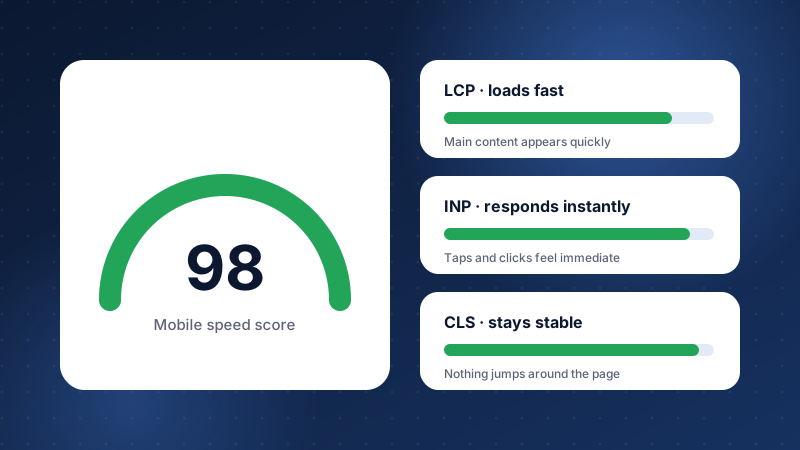
Google measures real-user experience with three main signals: how fast the main content appears, how quickly the page responds to taps and clicks, and how stable the layout stays while loading.
LCP: how fast it loads
Largest Contentful Paint measures when the biggest visible element, usually a hero image or heading, appears. Google considers 2.5 seconds or less good.
INP: how fast it responds
Interaction to Next Paint measures how quickly the page reacts when someone taps a menu or button. It replaced the older first-input measure. Around 200 milliseconds or less is good.
CLS: how stable it is
Cumulative Layout Shift measures unexpected jumping, such as a button moving just as you tap it. A score of 0.1 or lower is good. Set image sizes in advance to prevent most shifts.
Fixes that usually help most
Compress images and use modern formats, load fonts efficiently, remove scripts you do not use, delay non-essential widgets, and use caching. On many small business sites, images alone are the biggest win.
Choose a lean build
Heavy themes and stacks of plugins slow sites down. Clean, hand-built pages with little code usually load faster and are easier to keep fast.
Test on a real phone
Most visitors in India browse on mobile, often on average connections. Test your own site on a phone, not just a fast laptop, using PageSpeed Insights and Search Console.
Speed is part of the sales pitch
A quick, stable site feels professional and helps both visitors and search engines. It will not replace good content, but a slow site can waste even the best content.
Is your site slow? Ask us for a speed check or see how we build fast, custom websites.